
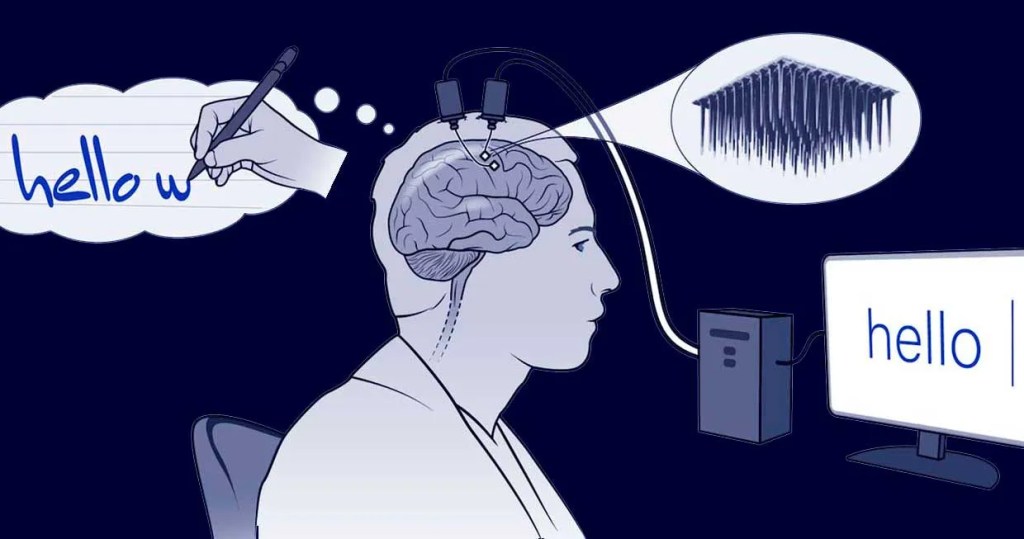
Our world is constantly evolving. From self-driving cars to advancements in ultrasounds, inventors, scientists, and doctors have created devices that make our lives easier in all different ways. It is apparent that brain injuries and disorders have a significant impact on people’s lives, but how have scientists worked to improve the daily lives of people who live with these disorders? In this brain talk, we will get into a brief introduction of a valuable new advancement which is Brain-Computer Interfaces, or BCI.
How do these magnificent new implants work and what are they? BCIs are systems that work to gain signals from our central nervous systems, analyze the signals, then translate the signals into a desired action [1] (Reference Image 1). Essentially, BCIs artificially elevate synaptic plasticity within the areas that connect neurons within our brains. Synaptic plasticity is a change that occurs in the synapses (the area that connects neutrons). This allows them to establish a better connection with one another [2]. This is especially useful for people that experience disorders where neural connection is lacking. BCIs are most commonly used for restoring function for people with disabilities. This includes neuromuscular conditions such as amyotrophic lateral sclerosis, cerebral palsy, and strokes. BCIs can even help people who have experienced head trauma or spinal cord injuries [1]. BCIs are a “step up” and continuation of what is known as HCIs which are simple keyboards and mouses that we use in our daily lives. Scientists believe that in the future, BCIs will potentially be able to aid with computing, robotics, gaming, and other areas of neuroscience other than rehabilitation. Scientists believe that in the future, BCIs might be used for improving the performances of surgeons and other medical professionals. BCIs are clearly astonishing systems that are dramatic scientific advancements (I mean, can you imagine having a computer in your brain?!), but how have scientists come to this achievement? Researchers have used electroencephalography (EEG), which measures electrical activity in different areas of the brain, and single neuron-based device control, which focuses on specific neurons to gain more information about them. Scientists and researchers have used these devices along with electrocorticography (ECoG) to continue advancing the design of BCIs and improving the complexity of cursors, robotic arms, prostheses, wheelchairs, and other devices. While BCIs are breathtaking and extremely innovative advancements, they have gotten the attention of and excited many scientists, engineers, clinicians, and the public. Currently, research information and use of BCIs are very restricted to labs and not the public. It is only accessible to patients with very severe disorders and there are limited trials. However, scientists are working to make BCIs more reliable and accessible to the public!

Image 1: [3] This image is used to demonstrate the process of how Brain-Computer Interfaces process signals. As we talked about, the inner workings of BCIs begin with feature extraction, which is essentially getting the signals from our nervous systems. Next, is feature selection, which narrows down the signal to ensure the most precise and best outcome. After, feature classification works to classify the type of signal being received and analyze it. Lastly, is feature translation which translates the signal into a desired action. In the image, we can see that this processing is being used to move and enable a connection between the brain and a prosthetic arm.
While Brain-Computer Interfaces are a fascinating new development, the creation of these devices is very new and has little research and experimental evidence. I hope this short article gave you an introduction to this captivating subject and inspires you to do further research on your own. Reach out for any questions or suggestions and see you next time on A Matter of the Brain!
Sources:
[1] Science Direct
[2] Queensland Brain Institute
[3] Eurek Alert
[4] Frontiers
 A Matter of the Brain
Leave a comment